
Is Pharmacogenomics Testing Worth It for Me?

Medicine has traditionally followed a “one-size-fits-all” approach. However, many patients have experienced situations where a medication does not work as expected, causes significant side effects, or requires multiple adjustments before the right dose is found.
This variability is often influenced by our genes.
Pharmacogenomics (PGx) is a rapidly growing field of medicine that studies how genetic differences influence the way individuals respond to medications. But many people still ask an important question:
Is pharmacogenomics testing really worth it for me?
Let’s explore what pharmacogenomics testing does, who may benefit from it, and when it makes sense to consider testing.
What Is Pharmacogenomics?
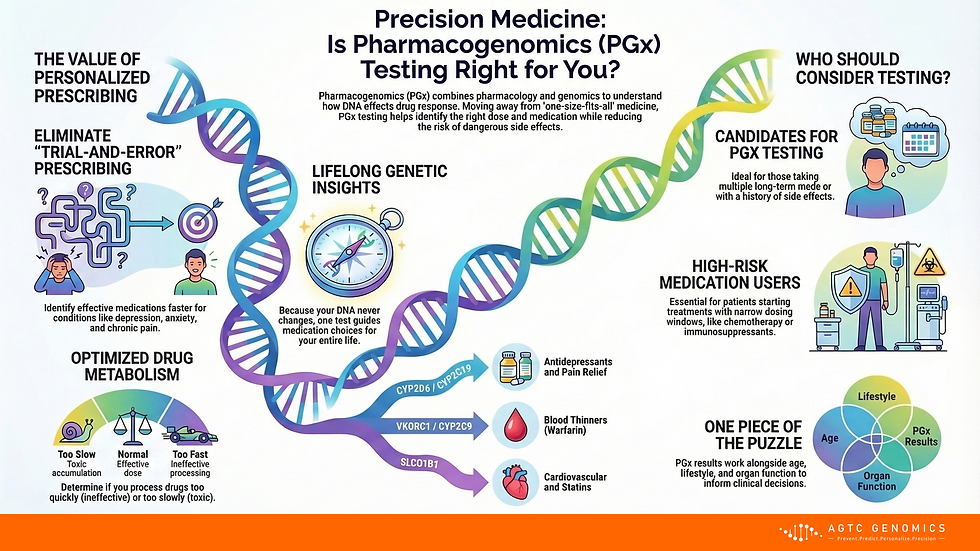
Pharmacogenomics combines pharmacology (the science of drugs) and genomics (the study of genes) to understand how genetic variations affect drug metabolism, effectiveness, and safety.
Your body processes medications through enzymes and biological pathways that are partly determined by your DNA. Certain genetic variants may cause a person to:
Metabolize drugs too quickly, reducing effectiveness
Metabolize drugs too slowly, increasing risk of side effects
Respond normally to standard medication dosing
Pharmacogenomics testing analyzes specific genes involved in drug metabolism, transport, and drug targets to help predict these responses.
Why Do People Respond Differently to the Same Drug?
Two patients can take the same medication at the same dose but experience very different outcomes.
Some common examples include:
Pain medications that provide relief for some but not others
Antidepressants that require several trials before the right one is found
Blood thinners where incorrect dosing may increase bleeding risk
Cancer therapies that only work in patients with certain genetic profiles
Genetic variations in genes such as CYP2D6, CYP2C19, CYP2C9, VKORC1, and SLCO1B1 influence how the body processes many commonly prescribed medications.
Pharmacogenomics testing can help doctors and pharmacists better understand these differences.
Potential Benefits of Pharmacogenomics Testing
1. Choosing the Right Medication Earlier
PGx testing may help identify medications that are more likely to work for you, reducing the need for trial-and-error prescribing.
This can be especially useful in conditions such as:
Depression and anxiety
Cardiovascular diseases
Chronic pain
Oncology treatments
Neurology disorders
2. Reducing Risk of Adverse Drug Reactions
Adverse drug reactions are a major cause of hospitalizations worldwide.
Certain genetic variants can increase the risk of severe drug reactions. Pharmacogenomics testing can help identify individuals who may require:
Alternative medications
Lower dosing
Additional monitoring
3. Improving Drug Dosing
For medications with narrow therapeutic windows, dosing can be challenging.
Examples include:
Warfarin
Clopidogrel
Certain chemotherapy drugs
Immunosuppressants
Genetic insights may help guide safer and more effective dosing strategies.
4. Long-Term Medication Planning
Unlike many laboratory tests, your genetic profile does not change.
A pharmacogenomics test performed once can provide useful information throughout your lifetime, helping guide medication choices whenever new treatments are prescribed.
Who Should Consider Pharmacogenomics Testing?
Pharmacogenomics testing may be particularly valuable for individuals who:
Take multiple long-term medications
Have experienced unexpected drug side effects
Have had medications that did not work as expected
Are starting high-risk medications
Have a family history of severe drug reactions
It may also be helpful for patients with chronic conditions that require ongoing medication adjustments.
When Pharmacogenomics Testing May Be Less Urgent
While PGx testing offers valuable insights, it may not always be necessary for every individual.
For example:
If you rarely take medications
If you are only prescribed short-term treatments
If your current medications are already working well
However, as precision medicine becomes more integrated into healthcare, PGx testing is increasingly viewed as a proactive health tool rather than a reactive one.
Limitations to Understand
It is important to recognize that pharmacogenomics testing does not replace medical judgment.
Medication response can also be influenced by:
Age
Liver and kidney function
Other medications
Lifestyle factors
Underlying health conditions
PGx testing provides one important piece of the puzzle, helping healthcare professionals make more informed prescribing decisions.
Is Pharmacogenomics Testing Worth It?
For many individuals, the answer depends on their medication history and health needs.
Pharmacogenomics testing can provide value by:
Reducing medication trial-and-error
Lowering the risk of adverse drug reactions
Supporting personalized medication choices
Providing lifelong insights for future treatments
As healthcare moves toward precision medicine, pharmacogenomics is becoming an increasingly important tool for safer and more effective treatment.
A New Era of Personalized Medication
Pharmacogenomics testing is no longer limited to research laboratories. It is increasingly being integrated into clinical care to help patients and healthcare professionals make better-informed medication decisions.
AGTC Genomics now offers PharmPGx™ Comprehensive Pharmacogenomics Testing, a next-generation sequencing (NGS)-based test designed to analyze multiple genes involved in drug metabolism and drug response.
The test provides insights into how your body may respond to commonly prescribed medications across several therapeutic areas.
PharmPGx™ is now available through selected pharmacies, clinics, and hospitals nationwide, including Alpro Pharmacy.
If you are interested in learning whether pharmacogenomics testing may benefit you, consider speaking with a pharmacist, healthcare professional, or genetic counselor to better understand your options.


Comments